

What if the ingredient you need is listed under a different name or in a form you don’t recognise? Searching for “regional ethnic ingredients online australia” can bring up scattered results, while a broad grocery search may miss the regional foods you know from home or want to cook with.
A product title alone may not tell you where an ingredient comes from, how much is in the pack, how to store it or whether it suits your recipe. Compare those details before choosing a supplier, especially when similar foods appear under different names or in different forms.
This guide explains how to search by food tradition and ingredient, compare product listings and decide whether an online marketplace suits your kitchen. Gonje connects shoppers with multicultural specialty foods alongside everyday groceries. Check current listings and item-level availability before ordering. We’ll cover what to look for, from product format and stated origin to storage, intended use and ordering conditions.
Key Takeaways
- Regional ingredients can reflect a place, cuisine or established cooking tradition; Australian native foods are just one part of the picture.
- Match an ingredient’s form, such as dried or ground, to the preparation your recipe calls for.
- Use a checklist to compare product facts and separate them from broad marketing language.
- For regional ethnic ingredients online australia, start with the recipe name, then try recognised alternate spellings or forms.
- Gonje connects shoppers with multicultural specialty foods and suppliers. Check current listings and ordering details to see what suits your kitchen.
Regional ethnic ingredients online in Australia: what are you looking for?
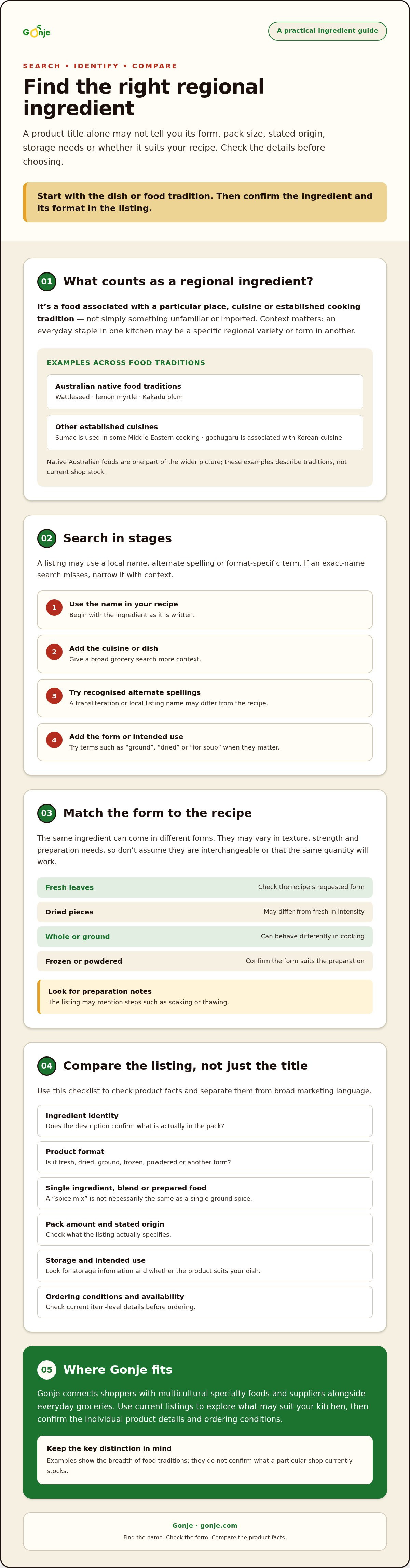
Regional ingredients are foods associated with a particular place, cuisine or established cooking tradition, rather than pantry staples chosen only for general use. The distinction depends on context. Rice or chilli may be everyday staples in one kitchen, while a particular variety or form is central to a regional dish in another. Looking for regional ethnic ingredients online australia can mean seeking an ingredient that connects a recipe to its food tradition, not simply something unfamiliar or imported.
General grocery searches can miss that distinction. A listing may use a local name, an alternate spelling or a format-specific term. A broad search may return familiar pantry basics instead of the ingredient you need. Naming the cuisine, dish or required form can narrow the results.
Native Australian ingredients and ingredients from other food traditions
Australian native foods are one part of this wider picture. Wattleseed, lemon myrtle and Kakadu plum are examples of ingredients associated with Australian native food traditions, but they don’t define the whole category. Ingredients from other cuisines and established traditions also fit: sumac is used in some Middle Eastern cooking, while gochugaru is associated with Korean cuisine. For broader context, the overview of Australian cuisine describes how migration has shaped the country’s food culture.
These examples show the range of the term, not what any particular online shop currently stocks. Check the current catalogue and individual product details before assuming an ingredient is available.
Why shoppers search for ingredients by region or cuisine
A search often starts with a meal in mind: a dish from a family food tradition, a recipe shared by a friend or something new to try. The ingredient name may not be obvious, particularly if the recipe uses a transliteration or a name that differs from local listings.
Search in stages. Start with the name written in your recipe. If results are limited, add the cuisine or dish, then try recognised alternate spellings. Include the form or intended use when it matters, such as “ground”, “dried” or “for soup”. This can help distinguish a useful match from a similar-sounding product that won’t suit the recipe.
This is a practical way to search for regional ethnic ingredients online in Australia: start with the food tradition, then check the actual product information. A platform such as Gonje can be a starting point for discovering multicultural specialty foods and suppliers alongside everyday groceries. Availability varies by listing, so confirm the product details before ordering.
How to identify regional ingredients and choose the right format
Finding the right ingredient is only half the job. A listing can name the correct food but offer it in a form that behaves differently from the one your recipe calls for. Whole, ground, dried, frozen and powdered versions can differ in texture, strength and preparation needs.
The same ingredient can be sold in several forms, and each form can change how it works in a recipe. Check ingredient identity and product format separately. Then establish whether the product is a single ingredient, a blend or a prepared food, and whether its stated use suits your dish.
Read ingredient names, spellings and descriptions carefully
An exact-name search may miss a listing that uses another spelling or transliteration. Try recognised alternatives, then read beyond the title. A product called a “spice mix”, for example, isn’t necessarily the same as a single ground spice. The description should help confirm what’s in the pack, its form, any stated origin and its intended culinary use.
This care reflects the breadth of Australia’s multicultural food scene, where familiar dishes and ingredients draw on many food traditions. A cuisine name can narrow a search, but it doesn’t replace checking the product listing.
Match the ingredient format to the way you will cook
Check the recipe before adding an item to your basket. Does it call for fresh leaves, dried pieces, a ground spice, frozen produce or something ready to use? Similar names don’t mean the formats are interchangeable. Dried and fresh ingredients may differ in intensity, while whole and powdered forms can behave differently in cooking. Don’t assume the same quantity will work for each.
- Check the form: Match the listing to the recipe’s wording, or look for recipe guidance if the formats differ.
- Read preparation notes: Look for instructions such as soaking, thawing, grinding or cooking before use.
- Review storage details: Check how the seller says to store the product, particularly if it needs refrigeration or freezing.
- Assess the description: Look for clear product facts, not just broad claims about flavour or tradition.
If a detail you need is missing, don’t guess. Compare another listing or ask the supplier for clarification before ordering. This is especially useful when searching for regional ethnic ingredients online in Australia, where names and formats can vary between suppliers. Gonje connects shoppers with multicultural specialty foods and suppliers. You can explore specialty food listings and check the information provided for each item. Confirm current listings and item-level availability before ordering.
Compare online ingredient listings with a simple checklist
Product titles can sound alike even when the contents, format or pack size differ. Compare the details side by side to make a decision based on product facts rather than broad claims such as “authentic” or “traditional”. Those descriptions don’t tell you exactly what’s in the pack or how it’s meant to be used.
| Ingredient name | Form | Origin | Pack details | Stated use |
|---|---|---|---|---|
| What ingredient is named? | Whole, ground, dried, frozen or other | Country or region, if stated | Weight, quantity and storage notes | Recipe or use described by the seller |
| Is it a single ingredient or a blend? | Does it match your recipe? | Is the claim specific or broad? | Will the amount suit your cooking? | Are preparation notes provided? |
Use the checklist for each product you’re considering. For regional ethnic ingredients online australia searches, a clear ingredient name and format are a useful start. Also check the description for blend components and any stated country or region of origin. Look for allergen, dietary and handling information that matters to you. Food Standards Australia New Zealand provides guidance on food labelling and allergen information; check its current advice if you need help understanding a label.
Compare quantity, storage and practical suitability
Pack details affect whether an ingredient suits your kitchen. Check the stated quantity and storage instructions, then consider whether the amount makes sense for one recipe or regular use. A larger pack isn’t automatically better value if you won’t use it or its storage needs don’t suit your pantry or freezer.
Compare like with like. A whole ingredient and a ground version, or a single ingredient and a blend, aren’t equivalent just because their names overlap. If origin, ingredients, quantity or storage details are missing, treat that as a question to resolve with the retailer, not proof of poor quality. Ask for the information you need before ordering.
Ready to compare? Browse Gonje’s current specialty-food listings as a starting point, then check each product’s details and availability before placing an order.
Find regional ethnic ingredients online: a practical search-to-order process
A recipe gives you a useful starting point, but finding the right product online takes a few checks. Use this five-step process to narrow your search, compare suitable options and confirm that the order can reach you.
- Identify: Write down the ingredient as the recipe names it. Note the cuisine or food tradition and the required form, such as dried, ground or frozen.
- Search: Try the exact name first. If results are limited, search a recognised alternate spelling or name, then add the cuisine and matching form.
- Compare: Check the listing’s ingredient name, description, quantity, storage notes and stated use. Make sure it’s the ingredient you need, not a blend or prepared product.
- Confirm: Check current availability and whether the item can be delivered to your address. Resolve gaps in product or handling information with the retailer.
- Order: Recheck the selected item and quantity before placing your order. Keep the recipe handy to confirm that the format still matches.
Turn a recipe into a precise ingredient search
Start with the recipe’s wording. Note the ingredient, cuisine or region, and required form. If the exact term brings up few relevant results, try a recognised alternate spelling or common name. Then add a practical descriptor, such as “dried” or “ground”, if that’s what the recipe calls for. This keeps the search focused without assuming that similar names refer to identical products.
Confirm the listing before placing an order
Read the current listing rather than relying on a search result or an old bookmark. Confirm the product identity, pack quantity and any storage or preparation notes the seller provides. Check delivery availability for your address as well. Availability can change, and delivery conditions may differ between items or sellers.
Confirm online availability on each current listing before you order. If an important ingredient detail or handling instruction isn’t clear, ask the retailer instead of guessing. This matters when a recipe depends on a particular form or preparation.
Searching for regional ethnic ingredients online australia is easier when you move from the recipe’s specific needs to a verified listing, one check at a time. Browse Gonje’s current specialty-food listings as a starting point, then confirm product details and delivery availability for your order.
Discover specialty ingredients through Gonje and plan your next order
Finding a suitable ingredient comes down to three checks: identify the food tradition behind the recipe, match the ingredient’s form to the way you’ll cook, and read the listing details before ordering. This gives you a clear path from “I need this for a dish” to a product that appears to suit your kitchen.
Gonje connects Australian shoppers with multicultural specialty foods and suppliers through an online platform. It’s a place to explore specialty foods alongside everyday groceries, rather than starting again with separate searches. The catalogue may not include every regional cuisine or ingredient, and availability can differ by item.
When a broader specialty-food marketplace can help
A broader marketplace can help you look across specialty-food listings in one place. Keep your search specific: use the ingredient name from your recipe, add its cuisine or tradition, and include the required form if it matters. Then check each result individually. A listing’s presence on a platform doesn’t confirm that it’s in stock or deliverable to your address.
Make your next order with confidence
Before browsing, jot down what the recipe calls for. Include the ingredient name, any alternate spelling you know and the preferred format. This short list helps you compare the right details without losing sight of what you’re cooking.
- Identify: Note the dish or food tradition and the ingredient it needs.
- Match: Record whether the recipe calls for a particular form or preparation.
- Check: Read the current listing for product details, pack information and storage notes.
- Confirm: Review the order conditions and check delivery availability for your address before checkout.
For shoppers searching regional ethnic ingredients online australia, checking the listing matters as much as choosing the right search term. Confirm the item, seller-provided information and delivery options before ordering. Ready to explore? Browse specialty foods on Gonje.
Make your next specialty-food search count
Finding the right ingredient starts with the dish you want to make. Identify its food tradition, match the ingredient’s form to the recipe, then compare the listing details. Check the product description, pack information and storage notes, and confirm the item can be delivered to your address before ordering.
These checks make regional ethnic ingredients online australia searches more useful. They help you look beyond a familiar name and decide whether a listing suits your kitchen, without relying on broad claims or assuming similar products are interchangeable.
Gonje connects consumers with multicultural specialty-food suppliers through an online platform. You can also find everyday groceries and ready-to-eat restaurant meals there. Specific ingredients, stock and delivery options can vary, so check the current listing and order details before you commit.
Ready to look for your next recipe ingredient? Explore specialty foods on Gonje, compare the details and choose what fits the meal you have in mind.
Frequently Asked Questions
Is it possible to buy regional ethnic ingredients online in Australia?
Yes, specialist shops and broader food marketplaces may offer regional ingredients for online ordering. What you can find depends on each seller’s current catalogue. Search by ingredient name, cuisine and product form, then read the listing to check what’s included. Before ordering, confirm delivery availability for your address. Don’t assume every seller stocks every ingredient or delivers every item to every location.
How do I find hard-to-source regional ingredients online?
Start with the exact ingredient name in your recipe. If that search brings up few useful results, try recognised alternate spellings, transliterations or a common name. Add the cuisine or region, then include the required form, such as dried or ground, if it matters. Compare product details, not just titles. If an important detail is missing, ask the retailer before ordering.
What should I check before ordering ethnic ingredients online?
Check the ingredient name, product form, listed origin, pack quantity and storage instructions. Review any allergen or dietary information relevant to you, and check the listed components if the product is a blend. Confirm that the seller can deliver the item to your address. Clear product information helps you decide whether it suits your recipe. If a detail you need isn’t provided, contact the retailer before ordering.
Are Australian native ingredients the same as regional ethnic ingredients?
No. Australian native ingredients are one category of regional food ingredients, not a synonym for all regional ingredients. Wattleseed and lemon myrtle, for example, have distinct culinary contexts. Regional ingredients can also refer to foods associated with many other cuisines and established traditions. Check the product’s stated origin and intended use. A broad category label alone won’t tell you exactly what an ingredient is or how it may suit your recipe.
Can one ingredient be sold in different forms online?
Yes. Depending on the ingredient and seller, it may be listed fresh, dried, ground, frozen or powdered. These forms may behave differently in a recipe, so check the product description and match the listing to the recipe’s preparation instructions. Follow any guidance on quantity and preparation. If the recipe doesn’t specify a form, consult a reliable cooking source or ask the retailer what the listing contains.
Does Gonje deliver every regional ingredient across Australia?
No. Gonje connects shoppers across Australia with multicultural specialty foods, but that doesn’t mean every ingredient is listed, in stock or deliverable to every address. Listings and delivery options can vary by item. Check the current product information and enter your delivery details during the ordering process. If the listing leaves an important question unanswered, confirm the details with the retailer before placing your order.
How can I tell whether an online ingredient listing suits my recipe?
Match the listing to the ingredient name, form and intended use in your recipe. Check whether it’s a single ingredient or a blend, then review the description, quantity and storage notes. Names can differ between cuisines and sellers, so read the full product information rather than relying on the title alone. If you’re still unsure, ask the retailer instead of substituting an item based on a similar name.


